Newsletter · 15 September 2026
You hire for ownership. Then you onboard it away.
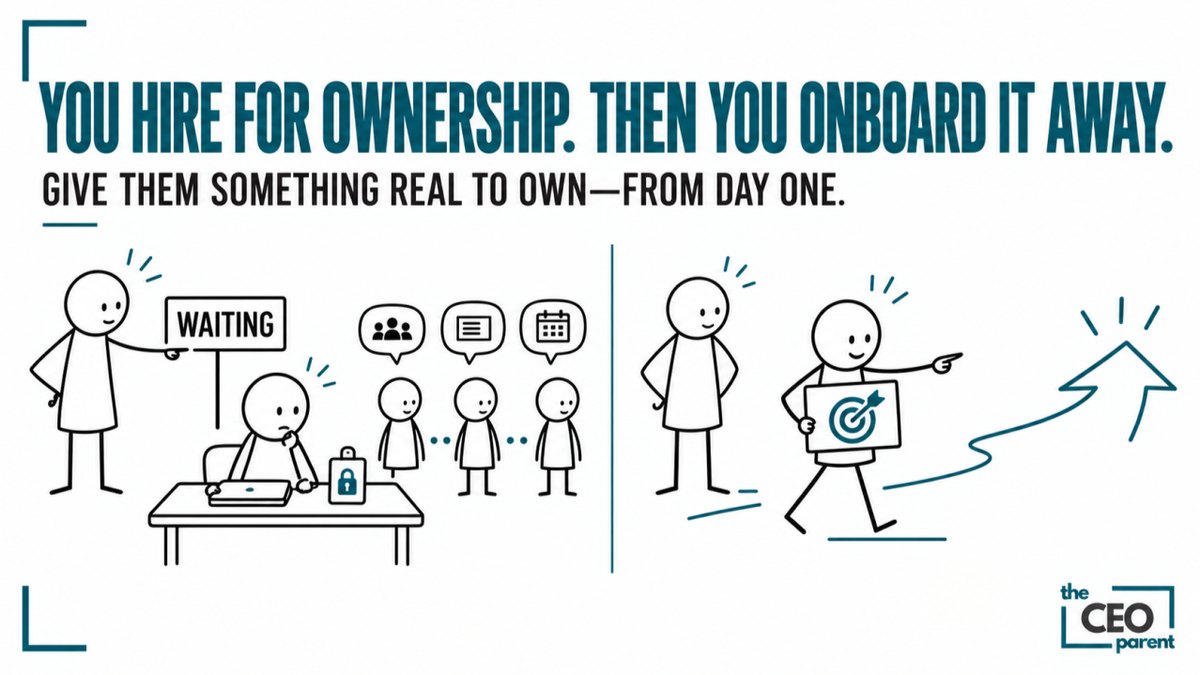
Here is your laptop. IT will sort your access by the end of the week. Sit in on two of this week's meetings, just to get a feel for things, and go and meet Sarah, then Tom, then whoever else has ten minutes. We will get you properly started next week.
That is how most people spend their first month inside a company that just hired them.
Nobody remembers, in that moment, why they hired this person in the first place. There was a reason, maybe even a business case: a gap nobody was closing, a decision that kept stalling, a bit of value sitting on the table that nobody had the capacity to pick up. You hired someone to think for themselves, act on their own, and add something that was not there before, however small. And from the moment that person walks through the door, most companies spend the next month training that exact instinct out of them.
Sitting in on meetings, meeting everyone, waiting for IT, waiting for access, waiting for the round of introductions to run its course: every one of those instructions is reasonable on its own. Together they teach a new hire the opposite of what you actually hired them for, which is to sit still until someone tells them what to do.
I am not immune to this either. When I bring someone new onto a client team, my first instinct is still to explain how everything works before I ask them a single question.
People are smarter than we give them credit for, and far more capable of figuring things out on their own than we assume. Most of them can work out how a tool functions, who owns what, and who to ask, without a month of hand-holding first. So give a new hire something real to think about from day one, point them at the people who can actually answer their questions, and then let them come to you when they get stuck, instead of hovering to check they are doing it right.
Ask them something back too. Not how are you settling in, but what looks strange to them, what nobody else seems to question anymore, what an outsider notices in the first weeks that everyone inside stopped seeing years ago. They are looking at your business with eyes you no longer have, and that answer can turn out to be worth more than the reason you hired them for in the first place.
This month, ask your newest hire the one question that could expose your biggest blind spot, and then actually do something with what they tell you.